Small House Lighting Guide
A practical step-by-step guide to small house lighting guide, including preparation, instructions, common issues, tips, and next steps.
Small House Lighting Guide
This guide explains how to approach small house lighting guide, including the preparation, practical steps, common mistakes, and final checks that help you finish with confidence.
Before You Start
Step-by-Step Instructions
Quick Reference
Common Problems When You Light a Small House
Even with careful planning, you might run into a few common issues when lighting a small house. Here's how to troubleshoot them:
Too Bright or Harsh Lighting
If your room feels overwhelmingly bright or the light is glaring, you might have too many lumens or fixtures, or the wrong type of bulbs. Solution: Install dimmer switches on your main light sources to reduce intensity. Replace high-lumen bulbs with lower ones, especially for ambient lighting. Choose bulbs with softer diffusers or frosted finishes to spread light more gently. Ensure task lighting is directed, not causing direct glare.
Too Dim or Gloomy Spaces
If your small house still feels dark or unwelcoming despite adding new lights, it usually means your layering isn't effective or you lack sufficient lumens for the space. Solution: Add more light layers. If you only have overhead light, introduce a few table or floor lamps for ambient light at eye level. Check the total lumen output for the room; you might need higher lumen bulbs for ambient lighting or more powerful task lights. Also, consider the color temperature – very warm light can sometimes feel dim if not balanced with enough brightness.
Uneven Lighting or Noticeable Shadows
Dark corners and stark shadows can make a small room feel smaller and less inviting. This happens when light sources are not well-distributed. Solution: Review your ambient lighting placement. Ensure lights are spaced evenly across the ceiling. If you have track lighting, adjust the heads to spread light more uniformly. Use wall sconces or portable lamps to illuminate dark corners. Mirrors placed opposite light sources can also help bounce light into shadowed areas.
Cold or Uninviting Light Color
If your small space feels like an office or a hospital room, your light's color temperature might be too cool (high Kelvin). Solution: Switch to bulbs in the 2700K-3000K (warm white) range for living areas and bedrooms to create a cozier atmosphere. For kitchens or bathrooms where clarity is needed, stay closer to 3500K-4000K (neutral white). Smart bulbs with tunable white options allow you to experiment with different temperatures.
Clutter from Fixtures and Wires
Small spaces can quickly feel overwhelmed by too many visible fixtures or tangled cords. Solution: Prioritize space-saving fixtures like recessed lights, flush mounts, or wall-mounted options. For plug-in lamps, choose slim designs. Invest in good cable management solutions: use cord covers, cable clips, or cord ties to keep wires hidden along baseboards or behind furniture. Consider wireless or battery-operated accent lights where possible.
Advanced Tips for Small House Lighting
Once you've mastered the basics, these advanced techniques can further enhance your small house lighting:
Maximize Natural Light
This is the most powerful tool for making a small space feel open and airy. Keep windows unobstructed by heavy drapes or blinds. Use sheer curtains or light-filtering shades that allow natural light to penetrate while maintaining privacy. Regularly clean windows to ensure maximum light transmission. Place your most used areas near windows to take advantage of daylight.
Strategic Use of Mirrors and Reflective Surfaces
Mirrors are a small house's best friend. Place large mirrors strategically opposite windows or a main light source to reflect light and visually expand the room. A mirror behind a lamp can double its effect. Incorporate other reflective surfaces like glossy furniture, metallic accents, or glass tabletops to bounce light around and add sparkle, making the space feel brighter and more dynamic.
Smart Home Integration and Automation
Take your smart lighting beyond simple app control. Integrate your lights with motion sensors in entryways or bathrooms for hands-free operation. Use smart routines to automatically adjust lighting based on the time of day, your location, or other smart home triggers. For example, lights could dim automatically when you start watching a movie, or gradually brighten in the morning for a gentle wake-up.
Vertical Lighting and Wall Washing
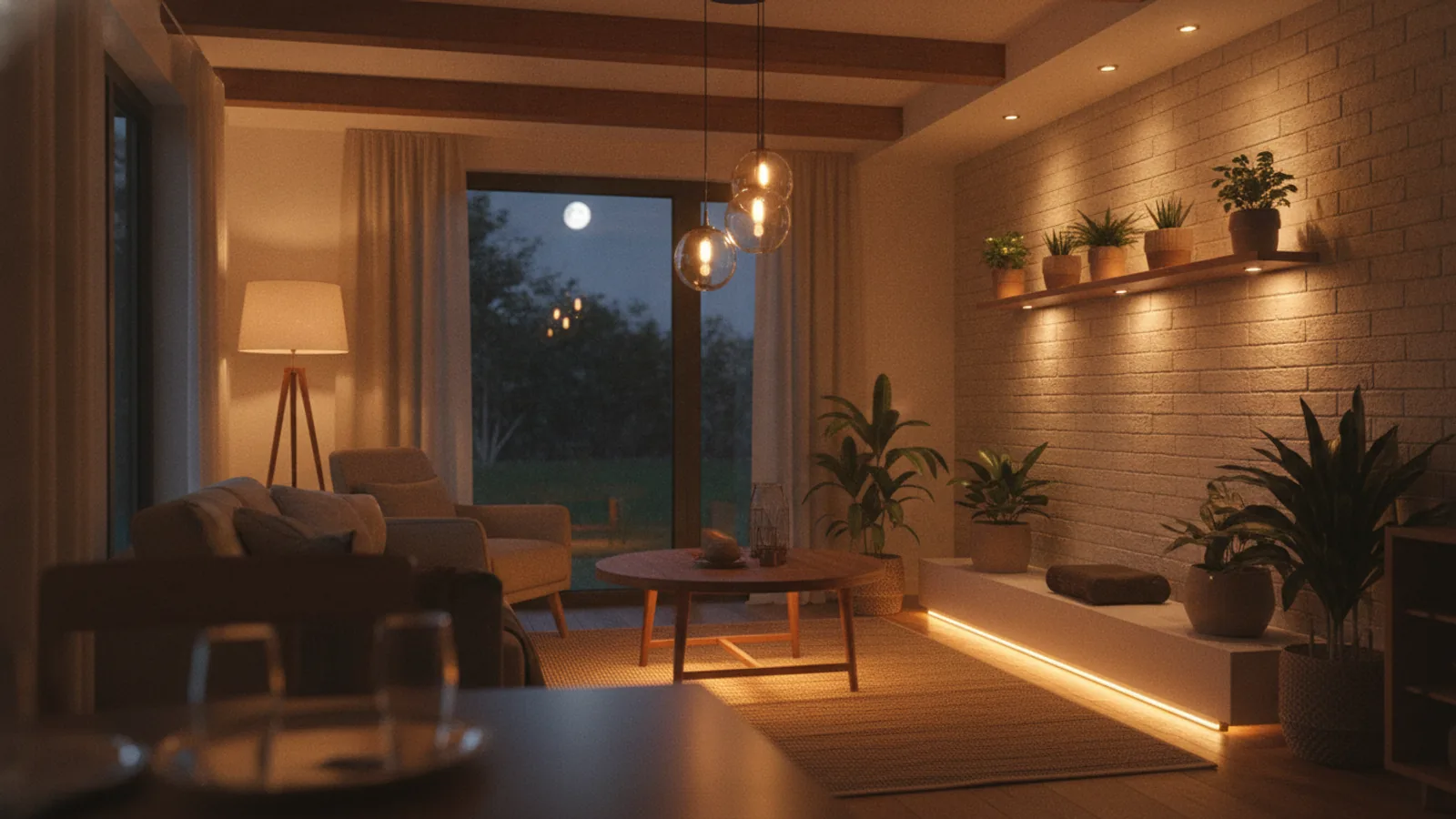
Drawing the eye upwards can make a ceiling appear higher and a room feel more spacious. Use wall-mounted fixtures that direct light both up and down, or strategically placed uplighters. Wall washing, which involves positioning lights to evenly illuminate an entire wall, can create a soft glow that expands the perceived size of the room and highlights wall texture or color.
Portable and Battery-Operated Lights
For ultimate flexibility, especially for accent lighting or areas without easy electrical access, consider high-quality portable or battery-operated lights. These can include small LED puck lights, rechargeable table lamps, or picture lights that you can move around to suit different needs or moods without needing an outlet.
Small House Lighting Guide FAQ
What's the best color temperature for a small living room?
For a small living room, 2700K to 3000K (warm white) is generally recommended. This range creates a cozy, inviting, and relaxing atmosphere, which is ideal for a space where you unwind. If your living room doubles as a workspace, you might want to incorporate smart bulbs that can switch to a slightly cooler temperature (around 3500K) for focused tasks, or use a dedicated task lamp with a neutral white bulb.
How can I make a small room brighter without adding more fixtures?
To brighten a small room without adding more fixtures, first ensure your existing bulbs have adequate lumens for the space. Then, focus on maximizing natural light by keeping windows clear and using sheer curtains. Strategic placement of large mirrors can significantly amplify both natural and artificial light. Using light-colored paint on walls and ceilings will also help reflect light. Finally, ensure your current fixtures are clean and that their light isn't obstructed by furniture or decor.
Should all lights in a small house be the same style?
No, not necessarily. While consistency can be visually pleasing, a small house can benefit from a mix of lighting styles as long as there's a cohesive theme or color palette. The goal is to avoid visual clutter and create a harmonious feel. You might use sleek recessed lights for ambient lighting, a functional desk lamp for task lighting, and a decorative wall sconce for accent. Mixing styles can add character, but ensure they don't fight against each other. Focus on scale and proportion – avoid oversized fixtures that overwhelm the space.
Can I use only recessed lights in a small house?
While recessed lights are excellent for ambient lighting and saving space, relying solely on them can make a room feel flat and lack dimension. They often provide light from directly overhead, which can create harsh shadows. It's best to combine recessed lights (for ambient light) with other layers like task lighting (e.g., table lamps, under-cabinet lights) and accent lighting (e.g., wall sconces, picture lights). This layering adds depth, visual interest, and ensures every area is well-lit for its specific function.
Final Checklist for Small House Lighting Guide
- Have you evaluated the specific functions and natural light in each room?
- Is your lighting plan incorporating ambient, task, and accent layers?
- Have you chosen appropriate color temperatures (Kelvin) for each area (e.g., warm for living, neutral for task)?
- Are the lumen levels chosen suitable for the size and function of each space?
- Have you selected space-saving fixtures that don't visually clutter the room?
- Are dimmer switches or smart lighting options included for flexibility?
- Have you sketched a detailed lighting layout, considering outlets and furniture?
- If performing DIY electrical, have you prioritized safety and turned off power?
- Have you tested the lighting at different times of day and adjusted as needed?
- Are all cables and wires managed to minimize visual clutter?
- Have you considered maximizing natural light with clear windows and light colors?
- Are mirrors or reflective surfaces used strategically to enhance brightness?